

Moana
When the Ancestor Steps Aside.
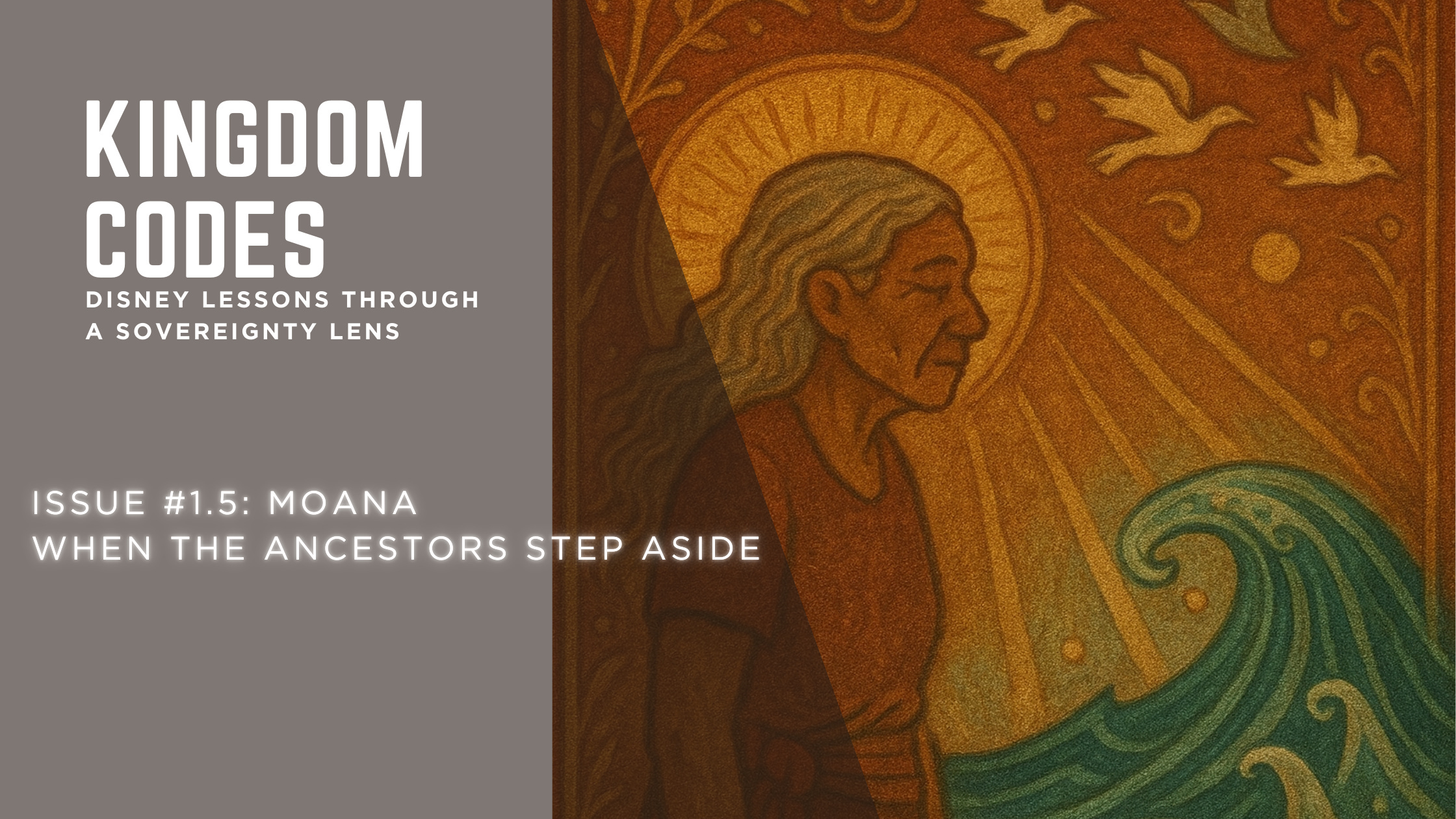
Welcome to Kingdom Codes, a series where I explore how modern stories reveal ancient truths. Disney may not call it cosmology, but the patterns are there. Consider this your onboarding into a deeper conversation about identity, calling, and sovereignty.
When the Ancestor Steps Aside
There is a moment in Moana that most people treat as sentimental necessity.
The grandmother dies. The hero cries. The journey begins.
That reading is lazy.
The grandmother does not exit for emotional impact. She transitions because the bloodline requires motion. Guidance cannot remain embodied once purpose demands agency.
This is not new storytelling. It is ancient architecture.
Across myth, scripture, and oral tradition, the pattern repeats: when the calling becomes unavoidable, the ancestor steps out of the physical role and into the guiding one. Not because they are gone, but because their presence must change form for the initiate to move forward.
Moana could not fully answer the ocean while still anchored to her grandmother’s physical authority. Leadership requires solitude before sovereignty.
This is the cost of becoming.
Ancestral Transition as Permission, Not Abandonment
The grandmother’s role is not to protect Moana from fear. It is to properly frame it.
She does not deny danger. She does not spiritualize risk away. She names fear, grief, anger, pain, and victory as inevitable companions. Tools, not distractions.
This is mature guidance. Not shielding. Not softening. Orientation.
In doing so, she gives Moana something more valuable than comfort: a script. A clear directive on how to approach Maui. What to say. How to stand. When to speak.
This mirrors a pattern seen repeatedly in biblical and mythological texts. Moses was not sent empty-handed. He was equipped. The staff. The signs. The authority to confront resistance not as personal ambition, but as assignment.
Tools are not proof of worth. They are confirmation of origin.
Both Moana and Moses are marked not by confidence, but by commissioning.
The Father as Curriculum
Early in the film, the grandmother names something most families avoid: the father was once like Moana.
Courageous. Curious. Drawn to the horizon.
Then came exposure to tragedy. Loss reframed his imagination. Safety replaced purpose. Risk became threat.
The grandmother does not shame him. She uses him as instruction.
This is ancestral leadership at its highest level. Trauma is acknowledged without becoming destiny. Patterns are named without condemnation.
Moana is not warned away from fear. She is warned about what happens when fear becomes policy.
This is the subtle inheritance many families pass down unconsciously. What Ruiz, in The Four Agreements, calls domestication. We become mirrors of our environment before we ever get the chance to ask who we are or why we came.
Without conscious ancestors, trauma becomes tradition. With them, it becomes wisdom.

Domestication, Identity, and the Ancestor’s Upgrade
Ruiz reminds us that before self-awareness, we absorb agreements. About safety. About worth. About possibility.
The role of the ancestor who has “crossed over” is not nostalgia. It is clarity. They have already lived the consequences of compromise. They understand the cost of shrinking.
That knowing is what makes them guides.
This is why ancestral figures across cultures gain influence after transition. Not because death grants power, but because distance grants perspective. They no longer need to protect their own survival. They can focus on alignment.
The grandmother does not become louder in death. She becomes precise.
Choosing Families as Curriculum
Across cultures, there exists a quiet, persistent idea: that we may choose our families before birth. Not as a romantic notion, but as a functional one.
If consciousness precedes form, then lineage is not random. It is curriculum.
This is not a claim to convince. It is a pattern to observe.
Bloodlines carry lessons. Some families teach courage. Others teach endurance. Some teach how to leave. Others teach how to stay too long.
The question is not whether we chose perfectly. It is whether we are willing to complete what was left unfinished.
Authorization Revealed
The ocean chooses Moana. God authorizes Moses. Not with explanations, but with movement.
Both stories insist on the same truth: purpose is not self-generated. It is activated.
And activation requires transition. Of comfort. Of protection. Of borrowed authority.
Before we ever ask who the adversary is, we should ask who prepared us for the journey.
This series is not about Disney. It’s about pattern recognition.
And this is only the first light placed on the road.
Reflection
If Moana teaches anything beyond courage, it is this: purpose does not begin when you feel ready. It begins when memory refuses to stay quiet.
The ocean does not persuade. It reminds.
The ancestor does not rescue. She repositions.
The path does not remove fear. It clarifies it.
What we inherit is not just story, but unfinished instruction. Some families pass down maps. Others pass down warnings. And some, quietly, pass down silence where a voice should have been.
The work is not to romanticize our lineage, nor to resent it. The work is to recognize where courage was interrupted and decide whether we will complete what was left unresolved.
Moana does not succeed because she is fearless. She succeeds because she listens. And in listening, she discovers that what felt like calling was actually recognition.
Continuing the Series
In the next installment of Kingdom Codes, the focus shifts from the individual journey to the collective inheritance.
Encanto is not about magic. It is about expectation.
It is about how families assign value, distribute responsibility, and mistake survival roles for identity.
Where Moana asks who will answer the call, Encanto asks who was never allowed to refuse it.
We’ll examine generational burden, unspoken agreements, and the quiet cost of being “the strong one” in a family system that depends on your silence to function.
Because sometimes the miracle isn’t discovering your gift.
It’s being allowed to lay it down.
The door remains open. The patterns continue.